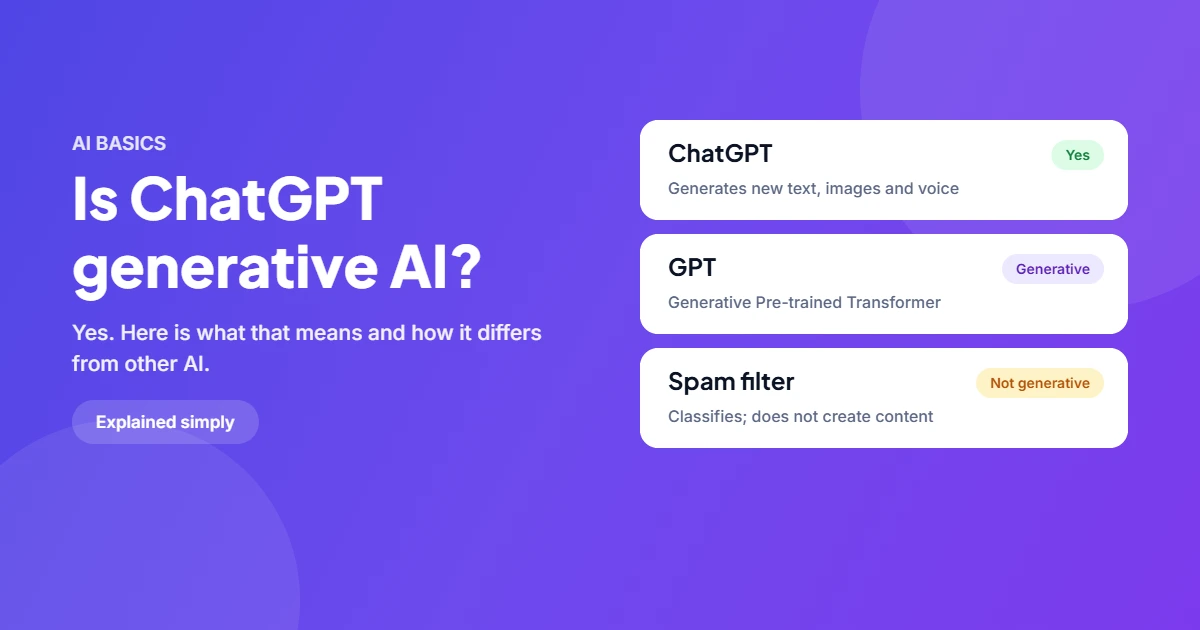
Yes, ChatGPT is generative AI. It creates new content, mainly text, in response to your prompts, and the “GPT” in its name stands for Generative Pre-trained Transformer. It is one of the best-known examples of generative AI, alongside image, music and video generators.
What is generative AI?
The US National Institute of Standards and Technology (NIST) defines generative AI as “the class of AI models that emulate the structure and characteristics of input data in order to generate derived synthetic content”, which “can include images, videos, audio, text, and other digital content” (NIST glossary).
Put simply: generative AI learns patterns from huge amounts of data, then produces something new that follows those patterns, such as a paragraph, a picture or a song.
Why ChatGPT counts as generative AI
- It generates new text. Each answer is written word by word in response to your prompt, not copied from a database.
- It’s built on generative models. ChatGPT runs on OpenAI’s GPT large language models: generative (they create content), pre-trained (on large text datasets) and transformers (the neural-network design they use).
- It creates more than text. Current versions can also make images and talk with voice, which are generative too.
OpenAI launched ChatGPT on 30 November 2022 (OpenAI). For the model history, see when GPT-4 came out.
AI vs generative AI
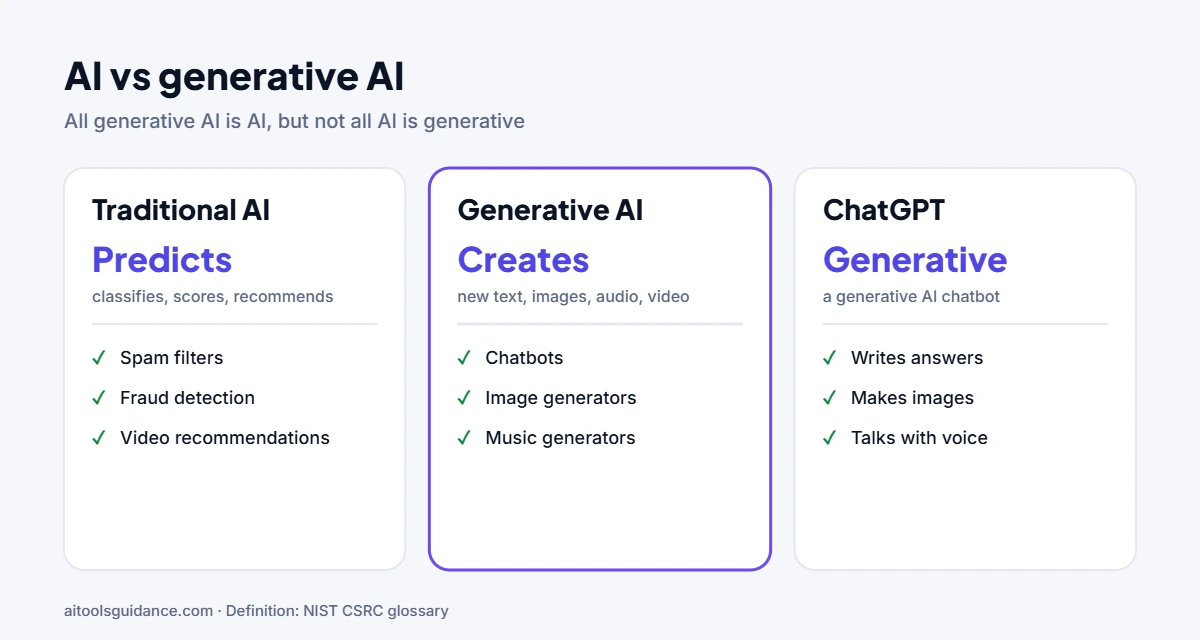
| Traditional AI | Generative AI | |
|---|---|---|
| Main job | Classify, predict or recommend | Create new content |
| Output | A label, score or choice | Text, images, audio, video or code |
| Examples | Spam filters, fraud detection, recommendations | ChatGPT, Gemini, Midjourney, Suno |
For a deeper look at how the two families of models learn, read generative AI vs discriminative AI.
What generative AI like ChatGPT can’t do
- Guarantee facts. It predicts likely text, so it can state wrong information confidently. Check important answers.
- Know everything recent. Without web search, it only knows what was in its training data.
- Replace your judgement. Schools and employers have rules on AI use; see does ChatGPT plagiarize?
Other examples of generative AI
Text: Google Gemini, Claude and other chatbots (compare them in Gemini vs ChatGPT). Music: Suno and Udio. Video and images: many tools in our AI tools directory. To get ChatGPT itself, see the official ChatGPT app.
FAQ
Is ChatGPT generative AI?
Yes. ChatGPT is a generative AI chatbot: it generates new text (and, in newer versions, images and audio) in response to prompts. The GPT in its name stands for Generative Pre-trained Transformer.
What does GPT stand for?
GPT stands for Generative Pre-trained Transformer: a model that generates content, is pre-trained on large amounts of text, and uses the transformer neural-network design.
What is the difference between AI and generative AI?
AI is the broad field of computer systems that perform tasks needing intelligence, such as recognising spam or recommending videos. Generative AI is the part of AI that creates new content, like text, images or music.
Is ChatGPT a large language model?
ChatGPT is a chatbot app built on large language models (LLMs) made by OpenAI. The LLM is the engine; ChatGPT is the product you talk to.
What are other examples of generative AI?
Text chatbots like Google Gemini and Claude, image generators like Midjourney and DALL-E, music generators like Suno and Udio, and video generators are all generative AI.
Sources: NIST CSRC glossary: generative artificial intelligence; OpenAI: Introducing ChatGPT. Checked 16 November 2026.