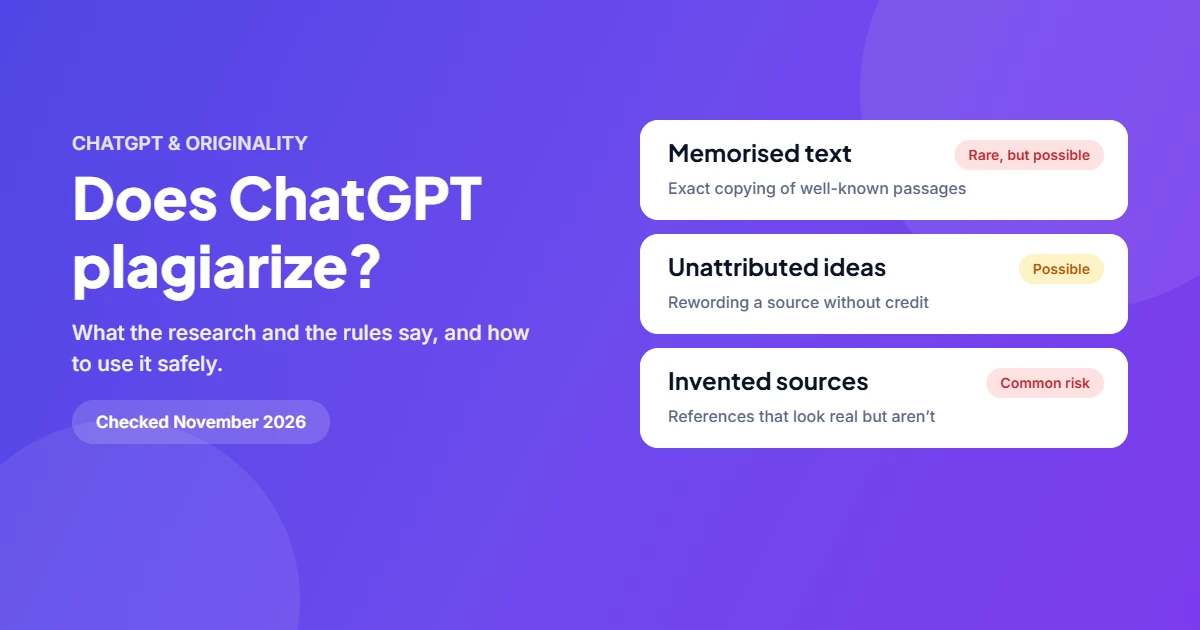
Short answer: ChatGPT does not copy and paste from a database, but it is not plagiarism-proof. It can occasionally reproduce memorised text, borrow ideas without saying where they came from, and invent sources that don’t exist. Whether you are plagiarising depends on how you use its output and the rules you work under.
What counts as plagiarism with AI?
Plagiarism means presenting someone else’s words or ideas as your own. Researchers who studied this question for language models split it into three types (Penn State, 2023):
- Verbatim: copying text word for word.
- Paraphrase: rewording or restructuring a source without citing it.
- Idea: using a source’s main idea without attribution.
There is also a fourth risk that is specific to AI: submitting AI-written work as your own. Even if every sentence is original, many schools and publishers treat undisclosed AI use as misconduct.
Does ChatGPT copy text word for word?
Not by design. ChatGPT is a large language model: it predicts the next words based on patterns learned in training rather than looking up and pasting documents. Most of what it writes is newly generated.
But “newly generated” is not the same as “never copied”. In the first study to test this directly, a Penn State team checked 210,000 texts generated by OpenAI’s GPT-2 against its roughly 8 million training documents. They found all three kinds of plagiarism. Larger models plagiarised more often, and fine-tuning on specialised material reduced word-for-word copying but increased paraphrase and idea plagiarism (ScienceDaily; paper). The study only covered GPT-2, because ChatGPT’s training data isn’t public, so it shows the risk exists rather than how often today’s models do it.
Verbatim reproduction is also at the heart of The New York Times‘ copyright lawsuit against OpenAI. The Times alleged that ChatGPT “regurgitated articles verbatim”; OpenAI responded that the examples came from prompts deliberately built to force that output. In March 2025 a federal judge narrowed the case but let its main copyright claims go forward (NPR). The court has not ruled on whether ChatGPT infringes.
In practice: exact copying is uncommon in everyday use, but it is more likely with famous passages, song lyrics, quotes, definitions and code that appears many times online.
The bigger risk: invented sources
A more common problem is that ChatGPT can produce references that look real but don’t exist. In a 2023 study in Scientific Reports, 55% of the works cited by GPT-3.5 and 18% of those cited by GPT-4 were fabricated (636 citations across 84 short papers; Walters & Wilder). Newer models do better, but the lesson holds: never cite a source ChatGPT gives you until you have opened it yourself and confirmed it says what ChatGPT claims.
This matters for plagiarism too. If ChatGPT summarises a real author’s argument without naming them, and you publish it, the idea is still theirs.
Who owns what ChatGPT writes?
OpenAI’s current Terms of Use say that, as between you and OpenAI, “you … own the Output”, and OpenAI assigns you its rights in it. The same terms add that “output may not be unique and other users may receive similar output” (OpenAI).
Two things follow. Owning the output is not the same as it being original, because someone else may have received near-identical text. And OpenAI’s terms can’t override your school’s or employer’s rules about AI use.
Is using ChatGPT plagiarism at school or work?
It depends on the policy you’re under, and policies vary widely:
| How you use ChatGPT | Plagiarism risk | What to do |
|---|---|---|
| Brainstorming topics or outlines, then writing it yourself | Low (often allowed) | Check whether your course or client requires disclosure |
| Editing grammar or clarity of your own draft | Low to medium | Disclose if your policy asks; APA recommends noting it |
| Pasting AI paragraphs into your work | High | Quote and cite it, or rewrite in your own words and disclose |
| Using facts, quotes or references it gives you | High | Verify each one at the original source and cite that source |
| Submitting a fully AI-written essay as your own | Very high | Treated as misconduct by most schools |
Will plagiarism checkers catch ChatGPT?
There are two different kinds of check, and people often mix them up:
- Similarity (plagiarism) checks compare your text with published sources and past submissions. They catch copied passages, including anything ChatGPT reproduced from the web, but not original AI text.
- AI writing detection estimates how likely it is that text was machine-generated. Turnitin shows this as a separate indicator from its Similarity Score. It needs at least 300 words of prose, shows scores below 20% as an asterisk to reduce false positives, and is meant as a data point for the instructor’s judgment rather than proof (Turnitin guidance via Arcadia University).
AI detectors can wrongly flag human writing, so a high score is a reason to talk, not a verdict. For more on how these tools work, see our reviews of GPTZero and AI Checker.
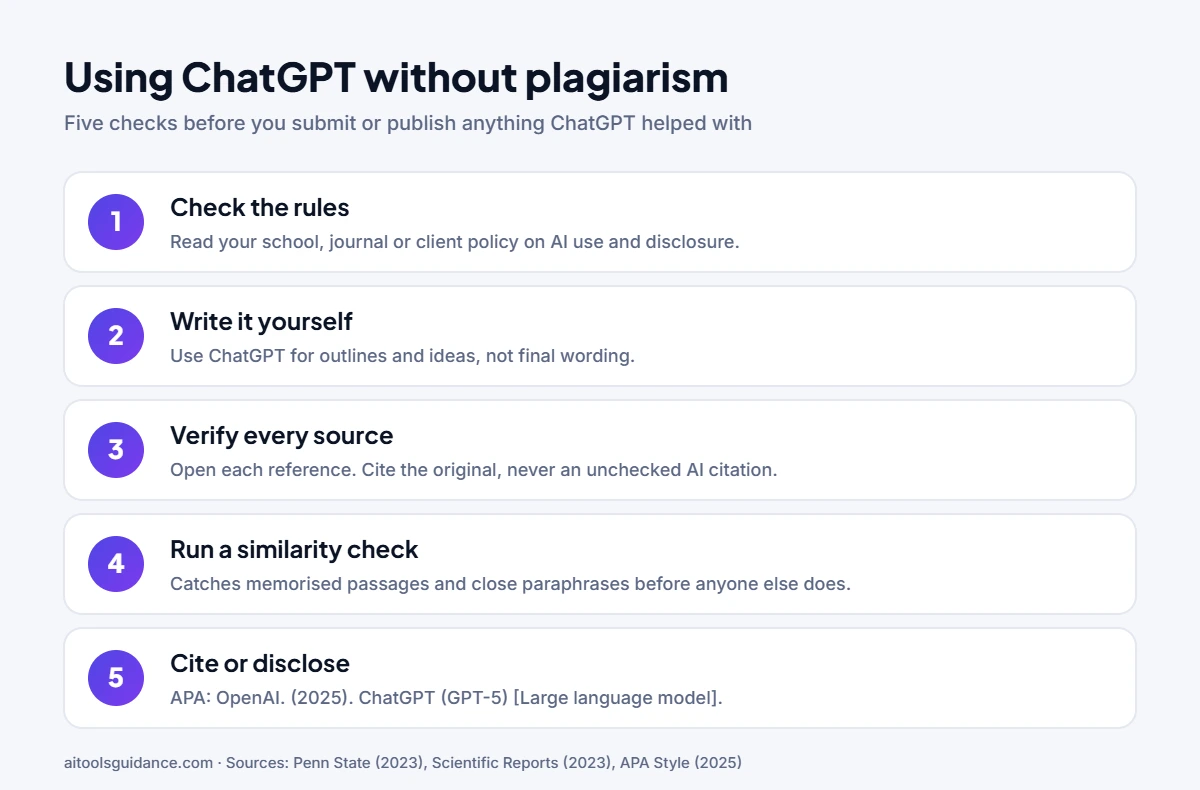
How to use ChatGPT without plagiarising
- Check the rules first. Read your course, journal or client policy on AI. Some ban it, some allow it with disclosure.
- Use it for thinking, not final wording. Ask for outlines, counter-arguments or explanations, then write the piece yourself.
- Verify every fact and source. Open each reference, confirm it exists and says what ChatGPT claims, and cite the original, not ChatGPT.
- Run a similarity check on anything important before you submit or publish it, to catch memorised passages.
- Cite or disclose ChatGPT when you use its output, following the style your institution requires.
If you’re writing academic work with AI help, our guide on how to use AI to write a paper walks through a responsible workflow.
How to cite ChatGPT (APA and MLA)
APA 7 (guidance updated September 2025) treats the company as the author:
OpenAI. (2025). ChatGPT (GPT-5) [Large language model]. https://chatgpt.com/
In the text: (OpenAI, 2025) or OpenAI (2025). APA also recommends describing how you used the tool, for example in a methods section or author note, and keeping your prompts (UBC Library summary of APA guidance).
MLA doesn’t treat the AI as an author. Describe the prompt, then give the tool, version, company, date and URL, for example: “Summary of plagiarism types” prompt. ChatGPT, model GPT-5, OpenAI, 11 Nov. 2026, chatgpt.com.
FAQ
Does ChatGPT copy text word for word?
Usually not. ChatGPT generates new text rather than pasting from a database, but research shows language models can occasionally reproduce memorised passages, especially well-known or frequently repeated text. Run a similarity check before you submit or publish anything important.
Is using ChatGPT considered plagiarism?
It depends on the rules you work under. Most schools and many publishers treat undisclosed AI-written work as academic or professional misconduct even when no sentence is copied. Check your policy, and cite or disclose ChatGPT when you use its output.
Can Turnitin detect ChatGPT?
Turnitin runs two separate checks: a similarity check that finds matching text in its databases, and an AI writing indicator that estimates how much of a document was machine-generated. The AI indicator needs at least 300 words of prose, hides scores below 20% to limit false positives, and is meant as one data point for the instructor, not proof.
Who owns the text ChatGPT writes for me?
Under OpenAI's current Terms of Use, you own the output and OpenAI assigns its rights in the output to you. The same terms warn that output may not be unique, so other users can receive similar text.
How do I cite ChatGPT in APA style?
APA's September 2025 guidance names the company as author: OpenAI. (2025). ChatGPT (GPT-5) [Large language model]. https://chatgpt.com/. In the text, write (OpenAI, 2025). Check your instructor's or publisher's rules too, as some require a disclosure note instead.
Sources: Penn State via ScienceDaily; Lee et al., “Do Language Models Plagiarize?”; Walters & Wilder, Scientific Reports (2023); OpenAI Terms of Use; NPR on NYT v. OpenAI; APA Style. Checked 11 November 2026.
Related: Is ChatGPT generative AI? · Does Grammarly use AI? · Which ChatGPT app is the real one?