Generative AI vs Discriminative AI: Key Differences Explained

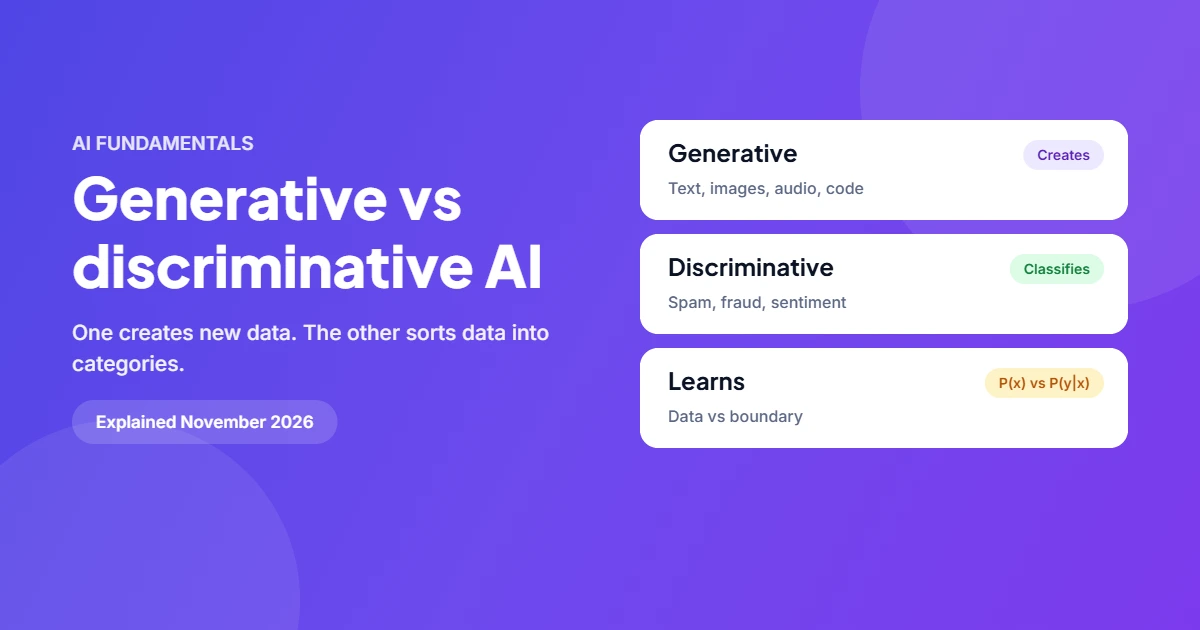
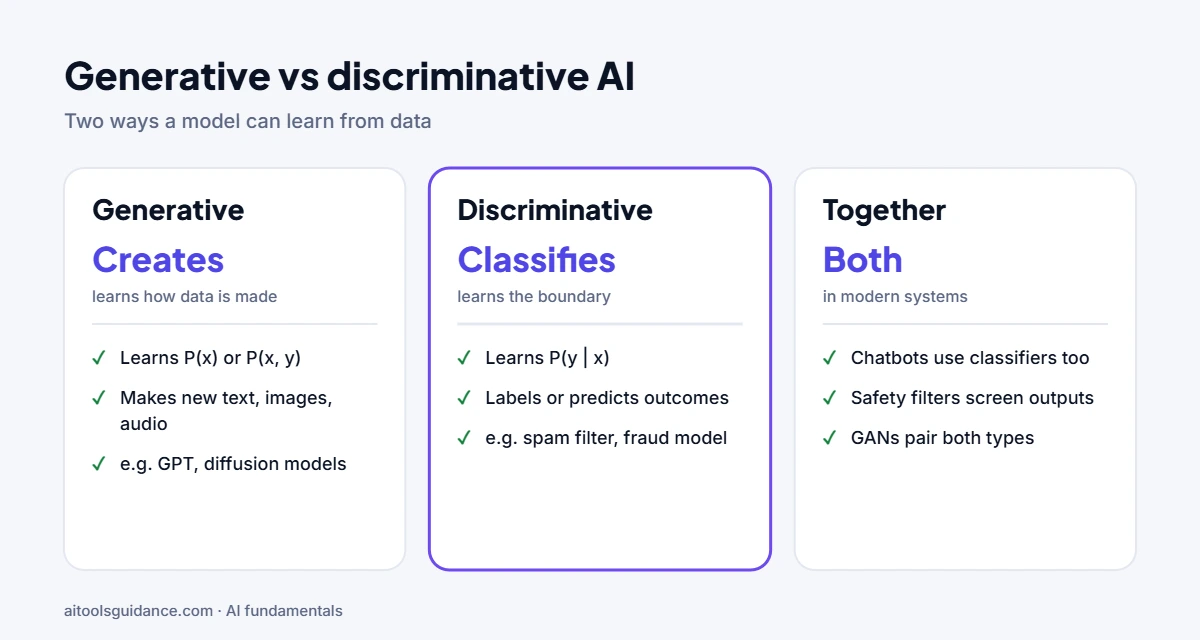
Generative AI learns how data is produced so it can create new examples (text, images, audio, code); discriminative AI learns the boundary between categories so it can label or predict (spam or not spam, fraud or not fraud). In probability terms, generative models learn P(x) or P(x, y), while discriminative models learn P(y | x).
Key differences
| Generative AI | Discriminative AI | |
|---|---|---|
| Goal | Create new data like the training data | Assign a label or predict a value |
| What it learns | The distribution of the data, P(x) or P(x, y) | The decision boundary, P(y | x) |
| Typical output | Text, images, audio, video, code | Class, score or probability |
| Examples | Large language models (GPT), diffusion image models, VAEs, Naive Bayes | Logistic regression, support vector machines, most image and text classifiers |
| Everyday use | Chatbots, image generators, voice cloning | Spam filters, fraud detection, face unlock, sentiment analysis |
| Data needs | Usually very large datasets | Often less data for a narrow task |
How generative AI works
A generative model learns patterns in its training data so well that it can produce new samples. A language model like the one behind ChatGPT predicts the next word again and again; a diffusion model starts from noise and removes it step by step until an image appears. See is ChatGPT generative AI? for more.
How discriminative AI works
A discriminative model ignores how the data was produced and focuses on what separates one class from another. Given an email, it outputs the probability that it is spam. It is usually simpler, faster and more accurate for classification tasks.
When to use each
- You need new content (drafts, images, voice): generative.
- You need a decision or label (approve, flag, sort): discriminative.
- Little labelled data: generative models can help by creating synthetic examples, but check them carefully.
They often work together
Real AI products combine both. A chatbot (generative) uses classifiers (discriminative) to filter unsafe content. Generative adversarial networks (GANs) train a generator against a discriminator. AI detectors are discriminative models that try to tell human from AI text, which is why they make mistakes; see our guide to AI detector accuracy.
FAQ
What is the main difference between generative and discriminative AI?
Generative AI creates new data by learning how data is produced; discriminative AI classifies data by learning the boundary between categories.
Is ChatGPT generative or discriminative?
ChatGPT is generative AI: it generates text by predicting the next word. Systems around it also use discriminative classifiers, for example for safety filtering.
Is a spam filter generative or discriminative?
Most modern spam filters are discriminative: they predict whether an email is spam. Naive Bayes, an older spam technique, is technically a generative classifier.
What is an example of a discriminative model?
Logistic regression, support vector machines and most neural-network classifiers used for images or text.
Are GANs generative or discriminative?
GANs are generative models, but they are trained using a discriminator network that learns to tell real data from generated data.
Sources: Standard machine learning definitions; see our generative AI explainer. Checked 24 November 2026.