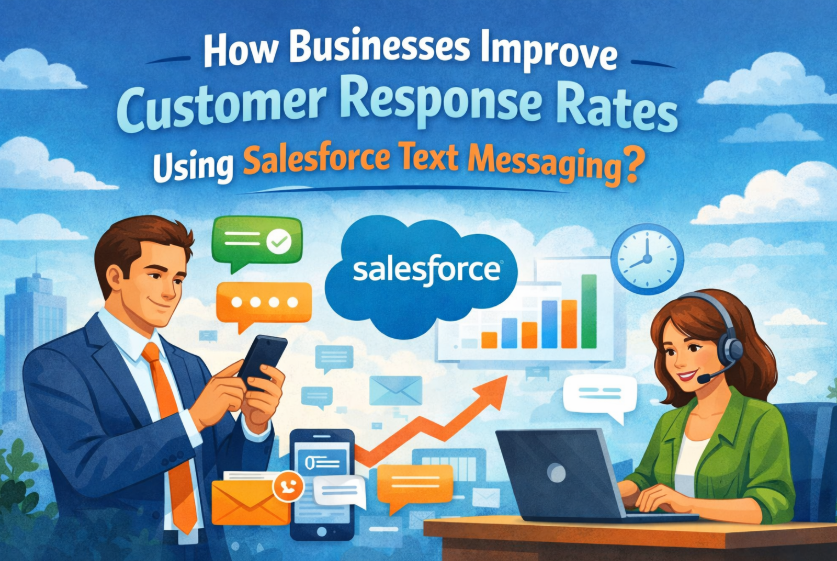
Seamless communication with customers is the key to business sustenance and consistent business growth. While there is no dearth of digital channels of communication, text messaging continues to be one of the most preferred channels of communication as this method allows businesses to establish instant connect with customers. With speed being the primary currency of trust, text messaging boasts an open and read rate of more than 98% compared to its email counterpart, which has a way lower open rate of 20%.
For organizations leveraging Salesforce, integrating SMS isn’t just about adding a new channel. Rather, it’s about leveraging CRM data to create a high-speed feedback loop. A Salesforce SMS App should be leveraged to optimize customer response rates.
However, several factors should be borne in mind while using an SMS App. While text messaging provides an excellent channel of interaction with audiences, yet without knowing the right method for optimizing your texts, all your effort to drive customer responses will go in vain.
Listed below are some tried and tested tips that can help you drive customer responses and reap better outcomes from your CRM-powered SMS App.
Instant Visibility: SMS messages are read quickly unlike emails that remain unread. Sending crucial reminders, updates or offers from Salesforce through SMS ensures immediate attention. This ensures rapid visibility and improved response rates.
Personalized Messaging: A Salesforce texting App taps into CRM customer data directly from Salesforce records. This enables highly personalized messaging that outperform generic texts in engagement and response rates. Relevant and timely texts that resonate with customers drive greater engagement and replies.
Two-Way Conversations: Unlike unidirectional alerts, today’s apps support two-way messaging. Customers can reply to a text in real-time besides solving issues. This makes interactions smooth and response times faster.
Automated Messaging: Automation ensures messages reach the customers exactly when they matter the most – after the creation of a lead, a case status updates, or a payment reminder. Since these messages are relevant and timely, they come across as helpful rather than non-intrusive, which increases response rates.
Faster Follow-ups by Teams: SMS enables support teams to follow up directly from Salesforce—without toggling between tools. Instant responses reduce lag, maintain momentum, and maintain client attention. By associating with customers at the right time, teams can optimize responsiveness, fortify relationships, and reduce the risk of losing opportunities.
Action-driven Messages: SMS messages are concise and driven by purpose. This allows organizations to include a clear call to action—appointment confirmation or postponement with one click. This focused approach removes unwanted steps, reduces friction, and encourages quicker and more assured customer responses.
Consistent Experience: By logging every discourse directly in Salesforce, businesses ensure continuity across the entire customer journey. Complete conversation history means clients never have to repeat themselves. This leads to better experiences and stronger engagement.
Compliance and Opt-In Management: By managing permissions and regulatory compliance by default, Salesforce SMS apps build trust. When customers realize that their preferences are respected and messages are relevant, they’re more persuaded to engage and respond.
Intelligent Routing: Robust messaging apps leverage AI-powered Salesforce text messaging features such as sentiment analysis, automated routing and more to ensure incoming customer messages immediately reach the right teams. By classifying and conveying messages, these systems reduce internal delays, allowing quicker action and customer responses. This creates a positive loop that meaningfully augments overall response rates.
All You Require Knowing About Salesforce SMS App and Why it Outshines Other Channels?
As a native solution, an SMS App for Salesforce allows businesses to send and receive messages directly within Salesforce. It maps SMS communication to key objects such as contacts, leads, accounts, cases, campaigns, and journeys. Every interaction is recorded by default, providing a unified view of client interactions. Such level of integration makes Salesforce SMS way more powerful and real than separate messaging tools.
Also Check: SWAPP
SMS outperforms other channels w.r.t customer engagement:
High visibility: Since messages land on the lock screen of a customer, it’s hard to ignore them. Instant reach: Most texts are opened and read within minutes of delivery.
Clear and concise: Text messages being concise are easy to absorb.
Everyday Acquaintance: Texting is a part of day to day interaction for most people.
An SMS App builds on these innate strengths by combining them with CRM-enabled personalization, smart automation, and analytics. This turns simple texts into real and data-powered conversations.
Read More: Quillbot vs grammarly
How Do Better Experiences Drive Better Response Rates?
Higher rates of response rates aren’t an outcome of better technology. Rather, they’re a result of better experiences.
An SMS app works because it:
- Compliments customers’ time
- Eliminates resistance from communication
- Delivers relevant and timely messages
- Feels natural, familiar and conversational
When customers appreciate the experience, they’re more motivated to respond. And when they respond, organizations can act faster, deliver optimal service, and develop stronger and lasting relationships.
Final Words:
Customer response rates do not just translate to numbers. They mirror the efficacy of an organization’s communication strategy. In an era of relentless digital noise, SMS continues to be a reliable and high-visibility channel that client’s respond to quickly. When SMS is directly integrated with Salesforce, businesses can offer real-time, automated, and tailored messages at every junction of the customer journey. A Salesforce texting app transforms how organizations network with their customers. This leads to quick and hassle-free interactions, increased rate of conversion, and a seamless experience that drives engagement.